
Childhood Hunger Is a Business Issue. Not Charity.
By Terrence Moorehead, Co‑Founder, RipLine Foundation
Derek shows up early, stays late, and covers shifts when his colleagues call out. He’s a transit security officer — the kind of employee companies count on.
What his employer doesn’t see is what happens after Derek clocks out.
Derek is a single father of three. Despite working full time, he runs out of food. He relies on food pantries, juggles bills, and stretches groceries. And on the days the math doesn’t work, he misses work — not because he’s unreliable, but because hunger has made his household unstable.
Derek isn’t an exception. He’s a snapshot of the modern American workforce.
And he’s the reason childhood hunger isn’t a charity issue. It’s a business issue.
Hungry kids today are absent workers tomorrow.
In 2024, the USDA reported that 6.7 million U.S. households with children were food‑insecure. The number is rising. Food insecurity is linked to lower math and reading scores, reduced attention and memory, higher absenteeism, behavioral problems, and a lower likelihood of finishing high school.
These aren’t soft outcomes. They’re early indicators of the workforce your business will rely on in five, ten, twenty years.
Bank of America’s community‑impact research called food insecurity a “barrier to economic mobility.” Their finding: hunger is shrinking hiring pools, increasing turnover, and raising financial stress among workers. They labeled it a macro‑economic issue.
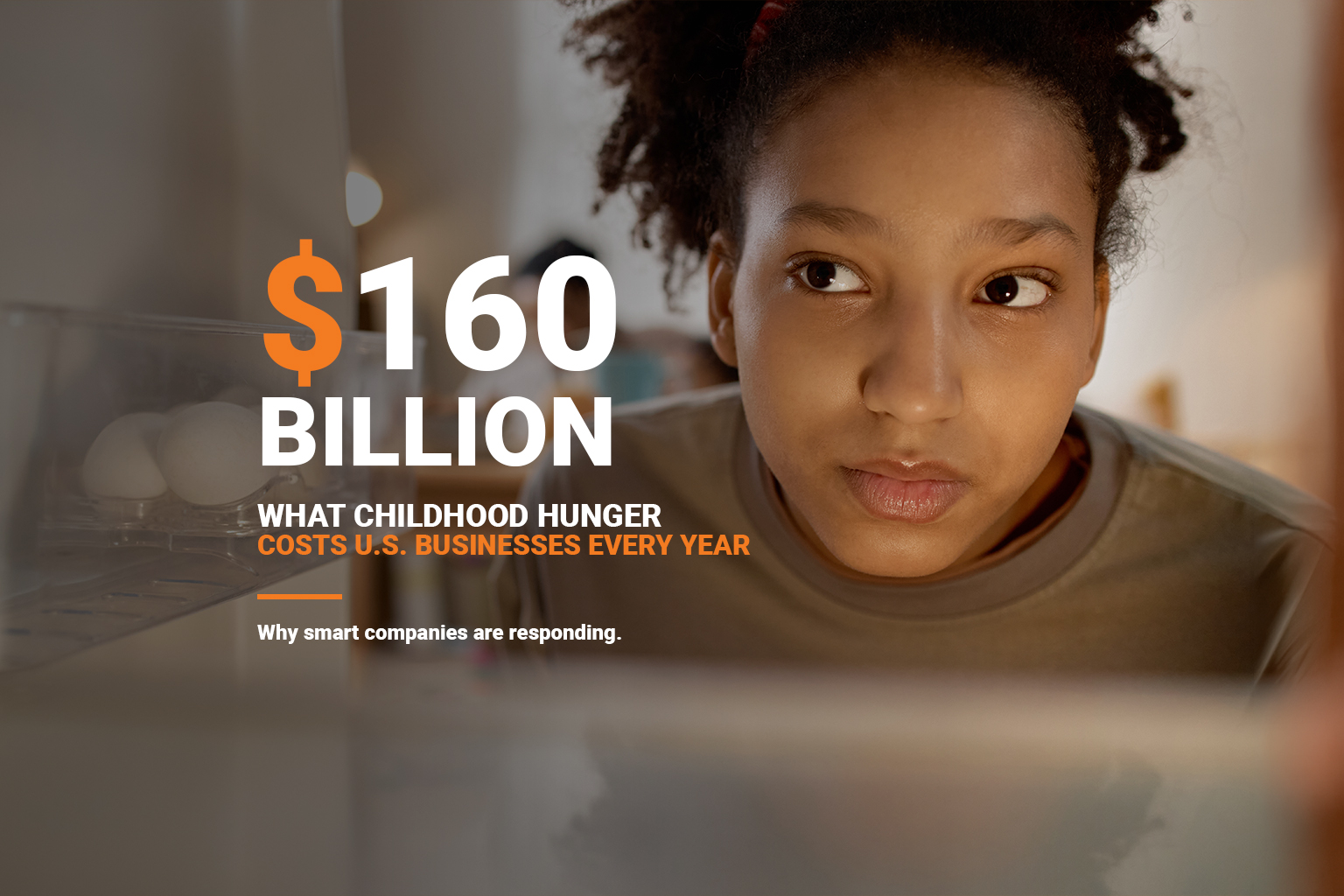
$160 billion. Every year.
Fast Company reported that childhood hunger costs the U.S. economy $160 billion annually in lost productivity, increased healthcare spending, and reduced lifetime earnings.
That’s not a moral argument. It’s a balance‑sheet argument. Businesses are paying for childhood hunger whether they invest in solving it or not.
Kaiser Permanente ran its own internal research and reached a blunt conclusion: “Hunger is costing us money.” Food insecurity among employees and their families directly increased healthcare utilization and reduced productivity. Food‑insecure employees showed higher rates of chronic illness, stress, and mental‑health challenges — all of which translated into higher employer healthcare costs and lower on‑the‑job performance.
Blue Cross Blue Shield found the same pattern in its Health Index research. Food insecurity in households with children was strongly correlated with higher healthcare claims — including mental‑health visits, chronic‑disease management, and emergency‑room utilization. They called hunger a “health‑system cost driver” that ultimately costs employers.
It’s not just tomorrow’s workforce. It’s today’s.
Childhood hunger doesn’t just hit the future workforce. It affects today’s — the parents who walk through the workplace door carrying the stress of not knowing if their kids will have enough to eat.
Claire is a certified nursing assistant. She started experiencing dizziness and fatigue during shifts. Her supervisor assumed it was a medical issue. The truth was simpler: she was skipping meals so her children could eat.
She eventually fainted on shift. Her employer saw a health scare. The real issue was food insecurity at home — walking into work in scrubs every day.
Research shows that food insecurity drives anxiety, which reduces task performance, work engagement, and the discretionary effort companies depend on for productivity.
Toyota found the same pattern in its U.S. manufacturing plants. Community‑impact studies showed childhood hunger in surrounding communities was directly affecting employee attendance, reliability, and safety: parents missing shifts when kids got sick from poor nutrition, workers arriving exhausted and distracted, safety incidents climbing. Toyota concluded that supporting childhood nutrition programs was essential to a stable, safe workforce.
School meals end. Shifts get missed.
Food insecurity is linked to higher school absenteeism, which undermines academic progress and long‑term workforce readiness. The effects ripple straight through the home and into the workplace.
Chelsie works part‑time at a grocery store. She often can’t afford the very items she stocks. Her two children rely heavily on school meals — but during school breaks, the family routinely runs out of food. During those weeks, she misses shifts because she has to take her kids to community meal programs and food‑bank distributions.
Her employer sees “availability problems.” The real issue is structural: when school meals disappear, parents’ work schedules collapse with them.
It’s not just a poverty issue. It’s a middle‑class issue.
Matt thought of himself as a typical middle‑class dad. He worked in a distribution warehouse and started missing early‑morning shifts because his children kept getting sick — a direct result of inconsistent access to nutritious food. When the kids were sick, he stayed home. When he stayed home, he lost pay. When he lost pay, the food got worse.
His employer saw “attendance issues” and rising healthcare costs. They didn’t see the root cause: hunger.
The USDA reports that households with children experience food insecurity at significantly higher rates than households without. The Center on Budget and Policy Priorities has documented how the rollback of benefit programs has reduced monthly support for millions of families just as grocery prices climbed — hitting families with children hardest.
Rising rents, child‑care costs, medical bills, and transportation are all pushing more middle‑income families closer to the edge. This isn’t a fringe story anymore. It’s a middle‑American story — and it’s impacting companies and employees across a surprisingly broad spectrum.
Smart companies are responding.
Denny’s didn’t enter the childhood‑hunger space because it was trendy. They entered because they saw the impact inside their own business: hourly employees struggling to feed their kids, managers reporting workers missing shifts or showing up exhausted, higher turnover in stores located in high‑hunger communities. CEO Kelli Valade has said publicly that supporting childhood nutrition isn’t just doing good — it’s protecting the workforce that keeps the business running.
Salesforce found the same pattern in its workforce. Internal employee‑wellbeing assessments revealed a surprising number of employees were struggling with food insecurity — leaders reported employees missing work due to food‑related family crises, declines in focus and productivity tied to household stress, and higher turnover among workers facing food and housing instability. Salesforce expanded emergency assistance programs and publicly acknowledged that basic‑needs insecurity was undermining workforce performance.
Toast, the restaurant‑technology platform, made a multi‑million‑dollar commitment to fight childhood hunger because they saw the direct economic impact across the restaurant industry: workers among the most food‑insecure in the U.S., kids relying on school meals, parents missing shifts when those meals disappeared in summer. Toast’s CEO, Aman Narang, called hunger’s impact on the restaurant workforce “profound” and treated addressing it as essential to the health of the industry.
A new approach. And a smart one.
Across industries, the pattern is the same. Childhood hunger destabilizes families. Destabilized families destabilize workers. Destabilized workers destabilize companies.
The challenge has been finding a meaningful, measurable way to make a difference.
Every mile turns into meals. RipLine channels the energy of outdoor athletes into the fight against childhood hunger.

That’s where the RipLine Foundation comes in. RipLine was founded by business leaders in Park City, Utah, to tap into one of the largest, most motivated, and most loyal communities in the country — outdoor athletes, adventurers, and weekend warriors. Last year, 168 million Americans got outside to move. About 164 million walked. 64 million ran. 60 million hiked. Over 40 million biked.
RipLine gives them an easy way to turn their miles into meals. Our Miles in the Wild™ challenge — one of our key challenges, built to rally the outdoor community and bring people together in the fight — lets anyone become a Force Multiplier. Sign up as a Leader, set a distance (50, 100, 200, or 400 miles), and walk, run, bike, or hike between May and September. The platform tracks miles (Strava‑integrated), collects donations, runs leaderboards, and keeps the community moving. Every dollar raised provides up to 10 meals for children in need. 100% of funds go to vetted partners on the front lines.
For businesses, partnering with RipLine is a strategic investment. It’s a direct line between your brand and a powerful, loyal, motivated consumer community — exactly the kind of audience marketers spend a fortune trying to reach. You can sponsor RipLine initiatives. Mobilize your team as Leaders. Or simply spread the word. In 2026, RipLine is committing to provide one million meals for children in need. Not someday. This year.
It’s good strategy.
If you’re a business leader, here’s the truth: you are already paying for childhood hunger — through absenteeism, turnover, healthcare costs, lost productivity, and reduced workforce readiness.
Supporting solutions like RipLine isn’t charity. It’s strategy.
If you believe kids shouldn’t pay the price for economic forces they can’t control — or if you simply want to invest in the workforce your business depends on — learn more or start a partnership at riplinefoundation.org.
Because solving childhood hunger isn’t just the right thing to do. It’s the smart thing to do.
Sources
USDA, “Household Food Security in the United States” (2024 report). · Fast Company, “The $160 billion cost of childhood hunger.” · Bank of America, community‑impact research on food insecurity and economic mobility. · Kaiser Permanente, internal research on food insecurity and employee health. · Blue Cross Blue Shield Health Index research on food insecurity and healthcare claims. · Toyota Motor North America, community‑impact studies. · Denny’s public statements (Kelli Valade, CEO). · Salesforce employee‑wellbeing program disclosures. · Toast public statements (Aman Narang, CEO). · Center on Budget and Policy Priorities.
Note: the names of the individuals featured in this article have been changed to protect their privacy.