
The Cost of Food Is Rising. Kids Are Paying the Price.
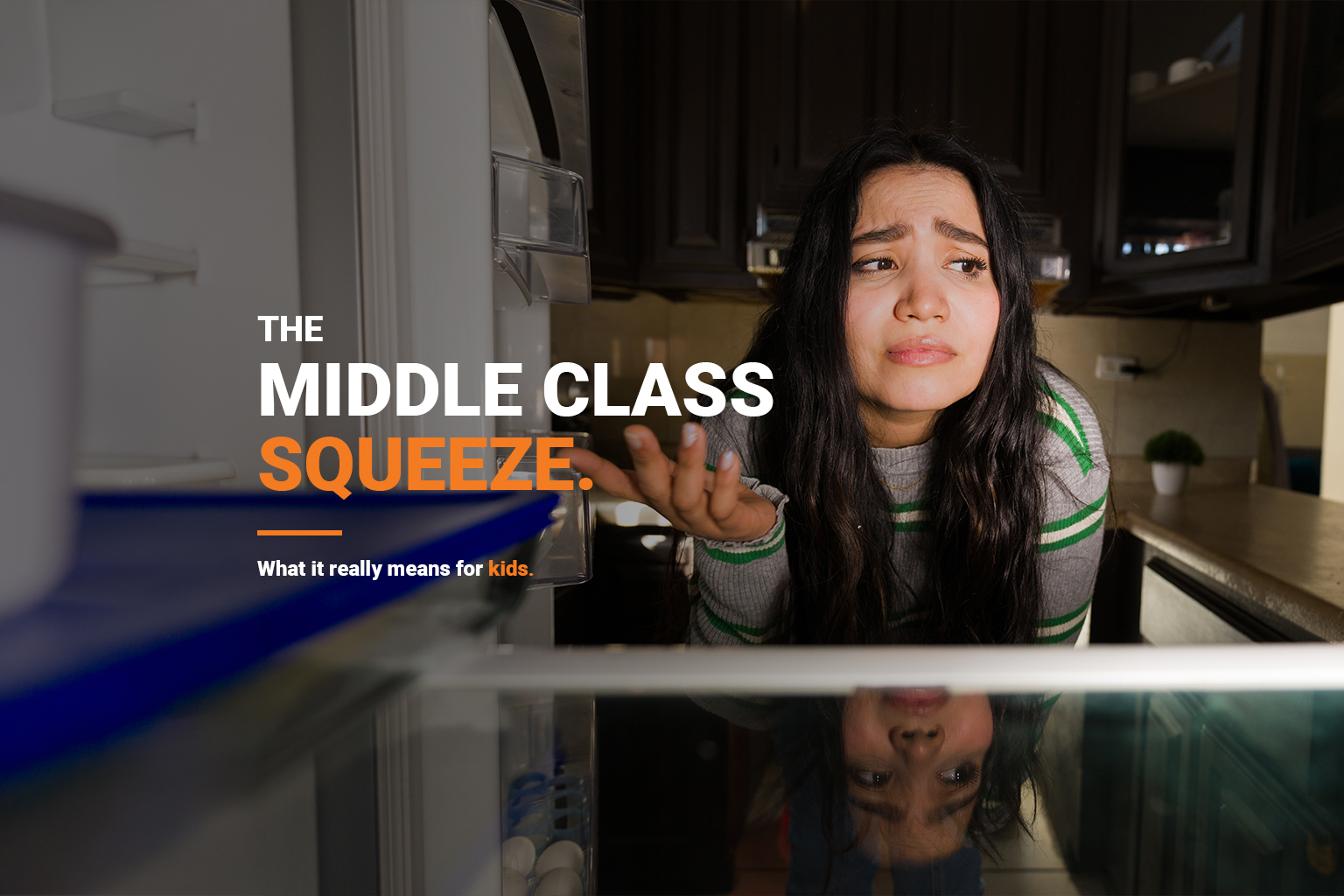
On a Tuesday night, a dad stands in the grocery aisle staring at a box of cereal like it’s a math problem. If he buys the cereal, he can’t get milk. If he gets milk, he can’t get fruit. So he does what too many parents do now — he buys the cheaper, less‑healthy option and tells himself he’ll make it work.
That’s not a rare anecdote. It’s the new normal for millions of American families with children.
When food gets expensive, kids lose stability.
Walk into a grocery store today and you can feel it — the quiet tension of families stretching dollars that don’t stretch anymore. Behind every tough trade‑off a parent is forced to make, there’s a kid absorbing the impact.
That’s the part we don’t talk about enough. Rising food prices aren’t just squeezing budgets. They’re reshaping childhood.
The USDA’s most recent Household Food Security report makes it clear: households with children are significantly more likely to be food‑insecure than households without. Families with children already spend a larger share of their income on food, so when prices rise, the shock hits harder and faster.
Feeding America reports food banks across the country are seeing elevated demand — driven by higher grocery costs and the expiration of pandemic‑era supports. Families aren’t lining up for extras. They’re lining up for the basics kids need to grow.
From a child’s perspective, here’s what rising prices look like: less fresh food. Fewer balanced meals. More cheap, low‑nutrition options. More uncertainty about what’s coming next.
Kids may not understand inflation, supply chains, or weekly budgets. But they can feel the instability.
Hunger shows up in kids long before it shows up in the data.
One of the most important findings from child‑nutrition research: kids feel the effects of food insecurity long before a household is officially counted as food‑insecure.
No Kid Hungry’s family surveys show the same pattern nationwide. When food gets tight, children start eating less variety, fewer fruits and vegetables, and more low‑cost, low‑nutrient foods. Parents cut quality long before they cut quantity.
The downstream effects on kids are well‑documented:
- Cognitive impact — difficulty focusing, learning, and retaining information.
- Behavioral impact — irritability, anxiety, acting out.
- Health impact — higher risk of chronic disease later in life.
- Emotional impact — kids absorb household stress even when parents try to shield them.
This isn’t about hunger pangs. It’s about childhood development.
The middle‑class squeeze is pulling more kids into the crisis.
The Center on Budget and Policy Priorities has documented how the rollback of benefit programs reduced monthly support for millions of families just as grocery prices climbed. That combination hit families with children hardest.
Here’s the part that surprises people: middle‑income families are increasingly reporting difficulty affording food for their kids.
Rising rents, child‑care costs, medical bills, transportation — they’re pushing more families closer to the edge. When one unexpected expense hits, the food budget is the first thing to bend. This isn’t a poverty issue anymore. It’s a national childhood crisis hitting middle‑class kids in a way we haven’t seen before.
What this really means for kids.
When food becomes unaffordable, kids lose more than meals. They lose energy to learn and play. Consistency in their daily routines. Confidence that their needs will be met. Health that should be building, not breaking. And the chance to grow up without having to carry adult problems.
The USDA, Feeding America, and child‑health researchers all document the same reality: food insecurity in childhood has long‑term consequences for education, health, and emotional well‑being.
Kids shouldn’t have to carry that weight.
The part we can actually change.
We can’t control supply chains. We can’t slow inflation or lower the price of groceries. But we can change what happens to kids.
That’s where the RipLine Foundation steps in — not as another charity, but as a new kind of force in the fight against childhood hunger.
RipLine was built on a simple belief: outdoor athletes, adventurers, and enthusiasts have more power than they realize. Mobilize them with purpose, and you can move mountains.
And here’s what most people miss — the army already exists.
According to the Sports & Fitness Industry Association, more than 164 million Americans walk for fitness. Over 64 million run. Nearly 60 million hike. Over 40 million ride bikes outdoors. The Outdoor Industry Association reports that 168 million people — 55% of the U.S. population — got outside to recreate last year. The highest participation rate ever recorded.
That’s not a niche. That’s a movement waiting for a mission.
Every day, millions of people lace up, clip in, shoulder a pack, or step outside to clear their head. They’re already logging the miles. They’re already doing the work. They just haven’t been connected to a purpose bigger than their personal best.
Three ways to move. One mission. Gravity Quest™ • Miles in the Wild™ • Balls Out™.

Three ways to move. One mission.
RipLine runs three peer‑to‑peer Leader challenges across the year — built so anyone can step in, whatever they love.
- Gravity Quest™ — the winter ski challenge. Set a vertical goal (50,000 to 400,000 feet), rally your sponsors, and shred the season for kids. January–February.
- Miles in the Wild™ — the spring/summer mileage challenge. Walk it, run it, bike it, hike it. 50 to 400 miles between May and September. Solo, with a friend, as a family, as a crew.
- Balls Out™ — the summer golf challenge. Play with purpose. Track holes, turn rounds into meals. Roughly 11 rounds gets you to 200 holes — and to $2,000 raised.
Same fundraising tiers across all three: $500, $1,000, $2,000, $4,000, or $10,000+. Same outcome: every dollar raised provides up to 10 meals for children in need, and 100% goes directly to vetted partners on the front lines (No Kid Hungry, Feeding America, Feed the Children, Vitamin Angels). No overhead. No dilution. Just fuel for kids.
Be a Leader. Be a Force Multiplier.
When you sign up as a RipLine Leader, you’re not signing up to donate. You’re signing up to lead. Pick your distance, your vertical, or your holes. Set your goal. Build your page. Then mobilize the people in your network — friends, family, coworkers, your run club, your ski tribe, your foursome, your group chat — and turn your movement into meals.
That’s the Force Multiplier effect. $100 of your own becomes $1,000+ once your network is in.
It’s built to be fun. You set your pace. You set your schedule. The platform tracks your effort, runs leaderboards, and keeps the community moving. You ride your bike, walk your dog, or hit the slopes — and a kid eats.
Get off the sidelines.
Most people who care about childhood hunger don’t take action because they don’t see how their everyday effort connects to a kid eating. RipLine connects it. Directly. Measurably. Every mile, every foot of vertical, every hole.
You don’t need to be elite. You don’t need to raise tens of thousands. You don’t need to wait for someone else to start a chapter. You just need to lace up, sign up, and bring your people along.
If you’ve ever moved your body for fun, you can move it for a cause. If you’ve ever told yourself you’d “do something” about an issue you care about — this is the something.
Sign up at riplinefoundation.org. Pick your challenge. Become a Leader. Move for a kid who can’t.
Because while we can’t control the cost of food, we can damn well make sure kids eat.
Sources
USDA, “Household Food Security in the United States” (most recent annual report). · Feeding America, food bank demand and pandemic‑era benefit data. · No Kid Hungry, family surveys on child food insecurity. · Center on Budget and Policy Priorities, analysis of benefit rollbacks and food prices. · Sports & Fitness Industry Association, U.S. participation data (walking, running, hiking, biking). · Outdoor Industry Association, 2024 outdoor recreation participation report.